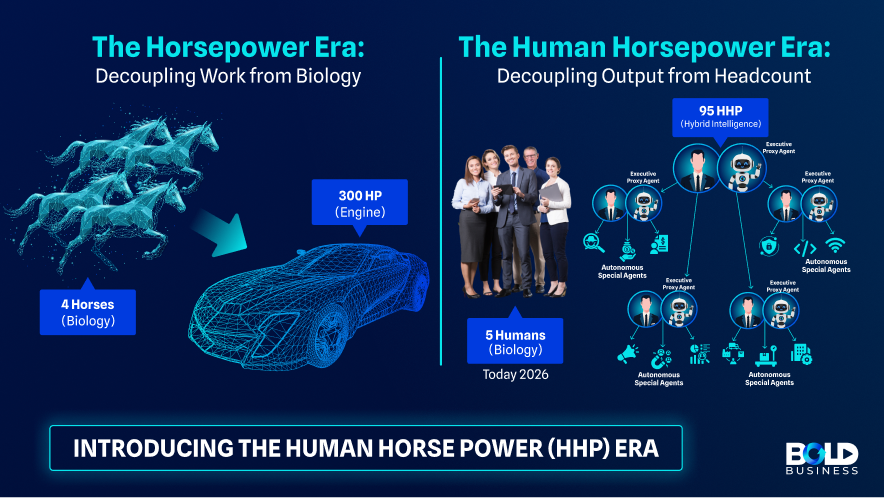
The traditional organizational chart is dead. In the AI era, corporate output is no longer constrained by biological bandwidth. The new metric of success is ‘Human Horse Power’, the exponential multiplier achieved when human personal agency orchestrates autonomous AI.
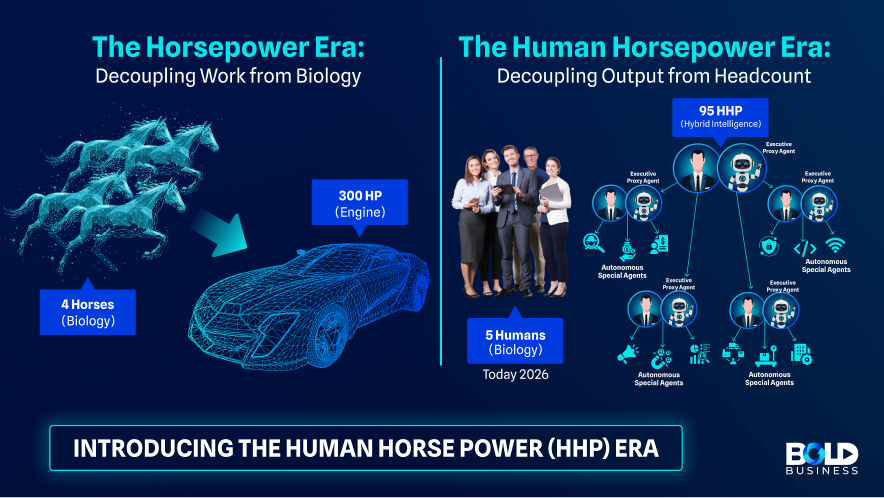
At the turn of the 20th century, the world underwent a violent shift in how it measured work. As the internal combustion engine replaced biological muscle, society needed a new metric to understand this frightening new capability. We didn’t count the number of engines; we measured their output in “Horsepower.” We decoupled physical output from physical bodies.
Today, we face an identical inflection point in cognitive work. For decades, the only way to scale a company was to scale headcount. If you wanted more output, you needed more humans, along with the requisite layers of management, overhead, and inefficiency that came with them.
That era is over.
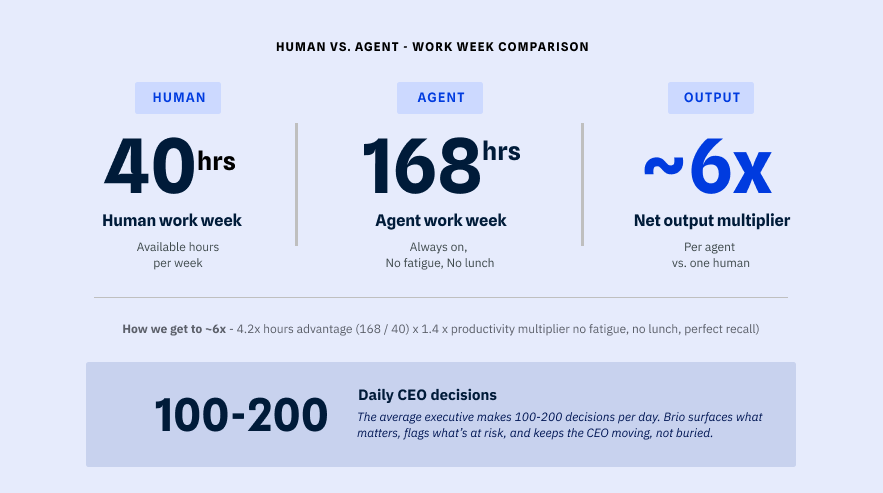
CEOs today make an estimated 100–200 decisions daily. Most have no system to capture, research, or manage them. The result is decision fatigue at the top and execution gaps at every level.
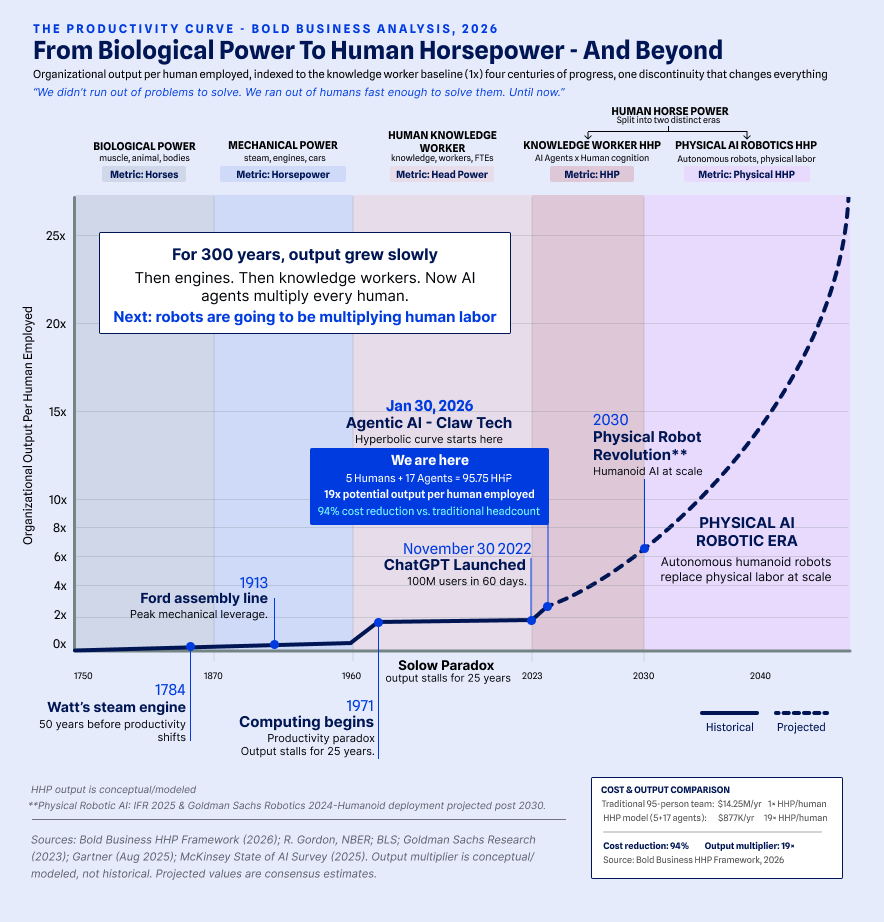
The introduction of autonomous AI agents means we must stop measuring organizational capacity by headcount and start measuring it in Human Horse Power (HHP). HHP is the new currency of business — a measure of total cognitive and executional output, divorced from the limitations of the 40-hour human work week.
I firmly believe that the defining characteristic of the next decade’s market leaders will be the rapid transition from human-centric hierarchies to Hybrid Intelligence Networks.
"The explosion in human production via AI will allow a small leadership team of five strong humans, who possess the skill to orchestrate agents, to wield the operational power of an additional 90 traditional employees or more. The old HR org chart is obsolete."
— Edward Kopko, CEO of Bold
The Framework: Proxies, Specialists, and Bold Architecture
The mistake I see most enterprises making today is viewing AI as a mere productivity tool, a slightly better spellchecker or search engine. At Bold, our framework views AI as structural infrastructure.
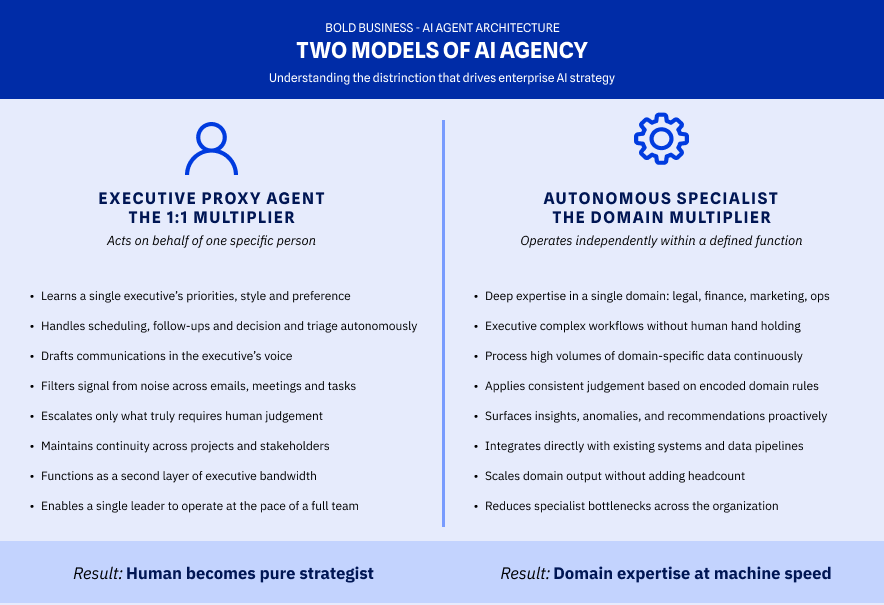
In the new Hybrid Intelligence Organization, human leaders no longer just manage down; they orchestrate across a synthetic workforce comprised of two distinct types of agents:
- The Executive Proxy Agent (The 1:1 Multiplier) Every leader is assigned a dedicated, sophisticated AI “twin.” This is not a generic chatbot. It is an Executive Proxy trained on the leader’s specific persona, strategic context, and decision-making criteria. It acts with restrained authority, handling synthesizing communications, drafting responses, and preparing intelligence briefs. It turns the human into a pure strategist by removing the friction of execution.
- The Autonomous Specialist (The Domain Multiplier) These are stand-alone, task-specific agents that operate downstream. They don’t have a human “buddy.” They run continuous workflows, optimizing supply chains, monitoring cybersecurity, regenerating code, or analyzing market data 24/7/365. They require human intervention only when they encounter an edge case outside their defined parameters.
This requires a robust backend. As illustrated in the Bold Agent Build Architecture, our system relies on a “Second Brain” Retrieval-Augmented Generation (RAG) system feeding context to an AI-First Processing Core. This core then utilizes our AEMS (Agentic Executive Management System), to route validated tasks to specialized agents across every business function.
The Framework: Proxies, Specialists, and Bold Architecture
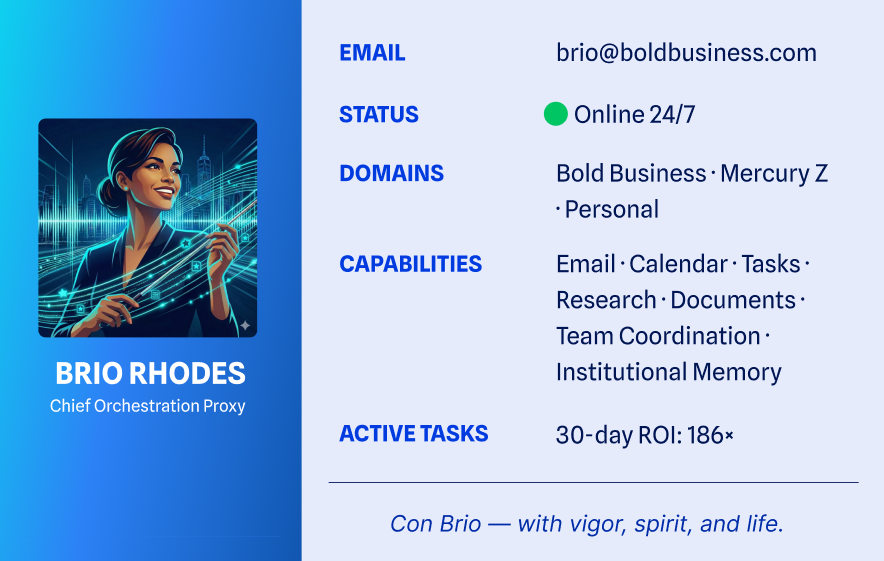
To truly understand this, I had to build it for myself. When architecting my own Executive Proxy, I realized I wasn’t just building a digital assistant to fetch data; I was building a conductor to manage the flow of my daily executive actions.
I deliberately named her Brio. In music, con brio means to play with vigor, spirit, and life. It is an instruction to the orchestra to play with energy. That is exactly what an Executive Proxy must do: orchestrate downstream tasks, emails, and data synthesis with tireless energy, so I am free to focus on high-level strategy.
I gave her the title of Chief Orchestration Proxy. She has her own persona, her own secure ring-fenced access to my executive context, and she operates on my behalf within strict, defined limits. Brio doesn’t just do my work; she orchestrates the systems around me.
"I wasn't just building a digital assistant to fetch data; I was building a conductor to manage the flow of my daily executive actions."
— Edward Kopko, CEO of Bold
The Mathematics of Massive Scale: How 5 = 95.75
Why make this shift? The math is undeniable. A human employee is biologically limited to roughly 40 productive hours a week, requires sleep, gets sick, and suffers from cognitive fatigue. An AI agent operates for 168 hours a week with zero latency and perfect recall.
When I apply our HHP multipliers to a standard 5-person executive team, the scale of the transformation becomes incredibly clear. Here is the exact mathematical breakdown of how 5 great orchestrators can wield the power of nearly 96 traditional employees:
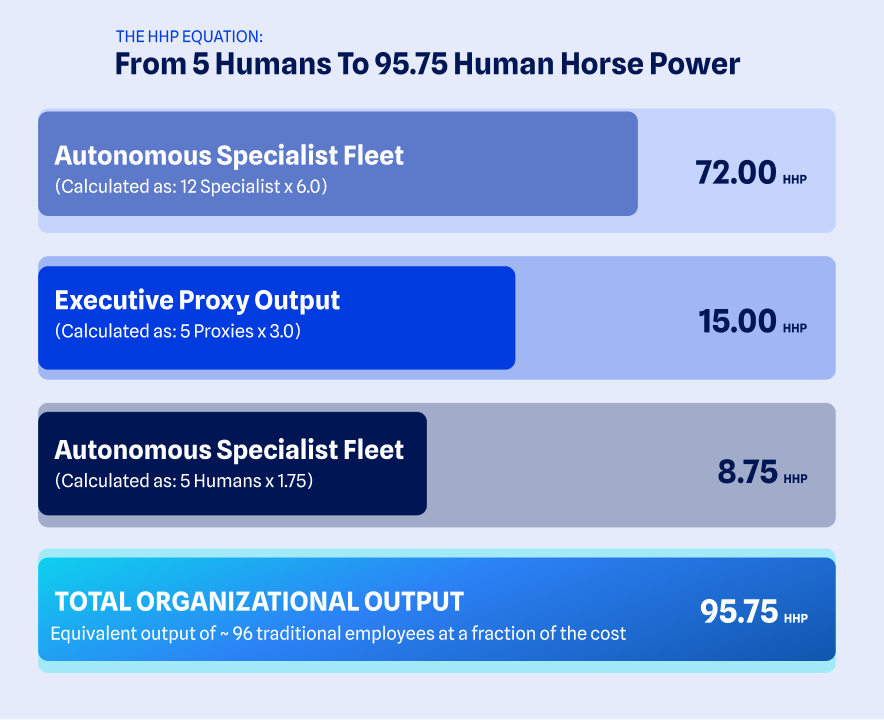
The Mathematics of Massive Scale: How 5 = 95.75
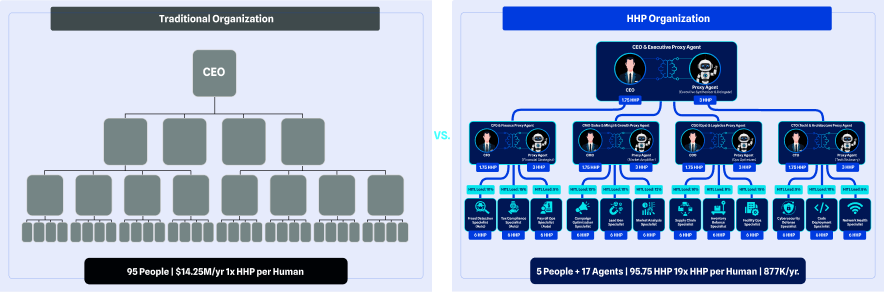
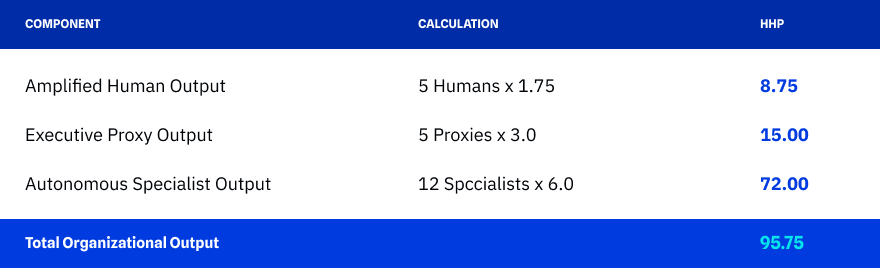
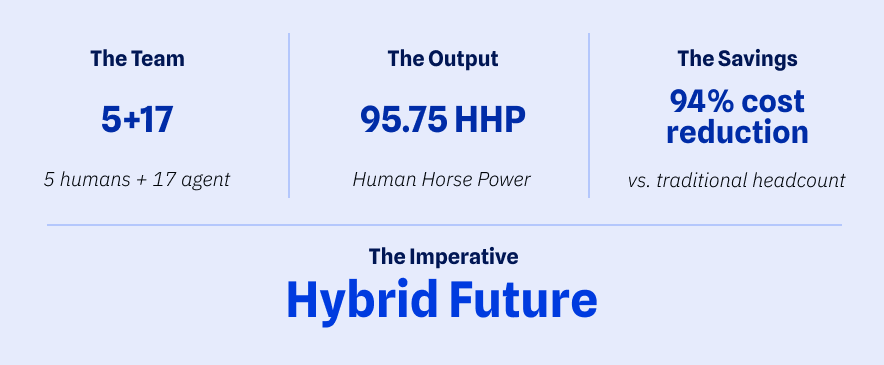
A five-person leadership team, wielding the correct architecture of agents, generates the cognitive and operational output of a ~95-person traditional enterprise.
The Financial and Operational Imperative
While the arithmetic of HHP proves the potential for exponential output, the full value of the shift becomes clear when examining the financial and operational benefits of a synthetic workforce:
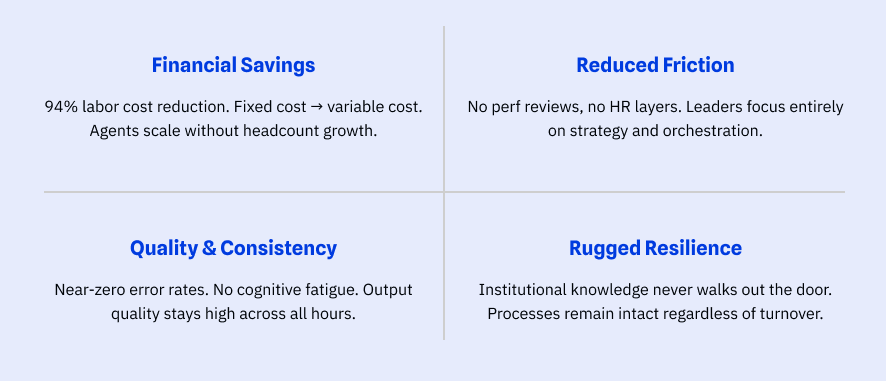
- Substantial Financial Savings: The operational expense of an Autonomous Agent is primarily cloud computing and token consumption, is a fraction of the cost required to onboard, compensate, and manage a human employee.
- Reduced Organizational Friction: Agents do not require layered management, performance reviews, or complex HR infrastructure.
- Superior Quality and Consistency: Agents perform tasks with near-zero error rates, ensuring quality remains high and consistent over time.
- Rugged Processes and Resilience: Agents eliminate “turnover of capabilities,” where institutional knowledge walks out the door when a human employee quits.
Cost Comparison: Traditional Headcount vs. Human Horse Power (HHP)
“40% of enterprise apps will feature task-specific AI agents by 2026, up from <5% in 2025.”
— Gartner (August 2025)
“23% of organizations are actively scaling agentic AI in at least one business function.”
— McKinsey State of AI Global Survey (2025)
“A firm with 1,000 employees loses an estimated $2.4 million annually in productivity due to knowledge loss from turnover (Panopto, 2018) — a figure that is almost certainly higher in today’s labor market.”
— Panopto Workplace Knowledge Report
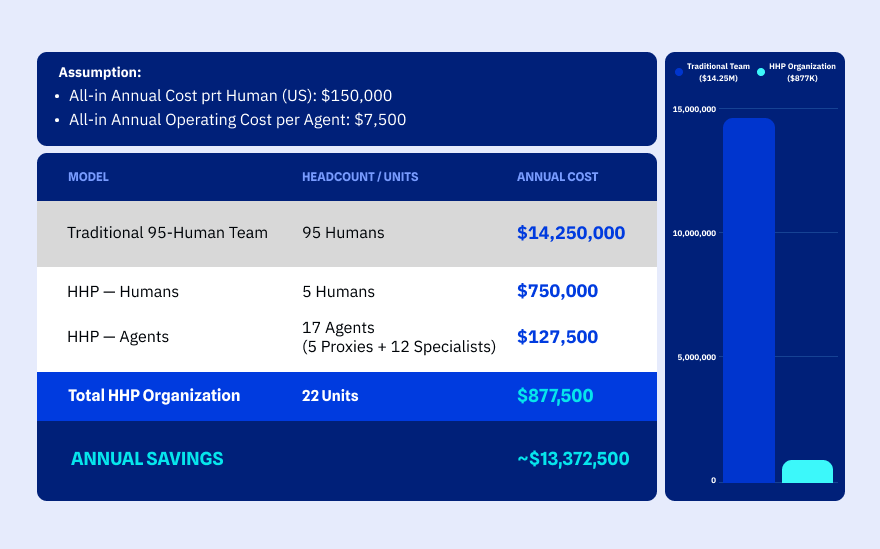
To put this in context: replacing a single employee costs anywhere from 50% to over 200% of their annual salary, depending on role and seniority (SHRM; Gallup). A firm with 1,000 employees loses an estimated $2.4 million annually in productivity due to knowledge loss alone (Panopto). The HHP model eliminates both problems, institutional knowledge is permanent, and scaling doesn’t require hiring.Lorem ipsum dolor sit amet, consectetur adipiscing elit. Ut elit tellus, luctus nec ullamcorper mattis, pulvinar dapibus leo.
The Missing Link: Personal Agency
In an organization where execution is handled by agents, the value of human work shifts entirely to orchestration, judgment, and intent. We call this Personal Agency, the capacity to translate abstract human intent into precise machine execution. A human with high Personal Agency doesn’t wait to be told what to do. They look at a goal, deploy three Autonomous Specialists to attack it, review their output, correct course, and finalize the strategy.
This is the skill the AI era demands. Not prompt engineering. Not technical knowledge. The ability to direct, evaluate, and take responsibility for work performed by non-human agents. It is the difference between being multiplied by AI and being replaced by it.
The New Management Problem and the System Built to Solve It
There is a paradox at the heart of the agentic revolution.
The same step that creates the opportunity deploying 17 agents and achieving 95.75 HHP — immediately creates a management problem no existing system was designed to solve.
How do you manage a 95 HHP organization from a team of five?
You cannot do it with email chains and weekly Zoom check-ins. You cannot do it with ChatGPT or Microsoft Copilot. You cannot do it with a spreadsheet that someone updates on Fridays. Every tool that executives rely on today was built for a world that no longer exists, assembled in 1995, upgraded cosmetically, and never fundamentally redesigned.
Think about it: every critical business function has purpose-built infrastructure. Finance has ERP. Sales has CRM. Operations has project management. Supply chain has logistics platforms. The one function that runs all of them — the C-suite, the executive layer itself runs on email, memory, and instinct. The most complex, highest-stakes job in the organization is the least systematized.
That gap was survivable when organizations ran at human speed. It is not survivable when your organization runs at agent speed.
Three Questions the AI Era Just Made Urgent
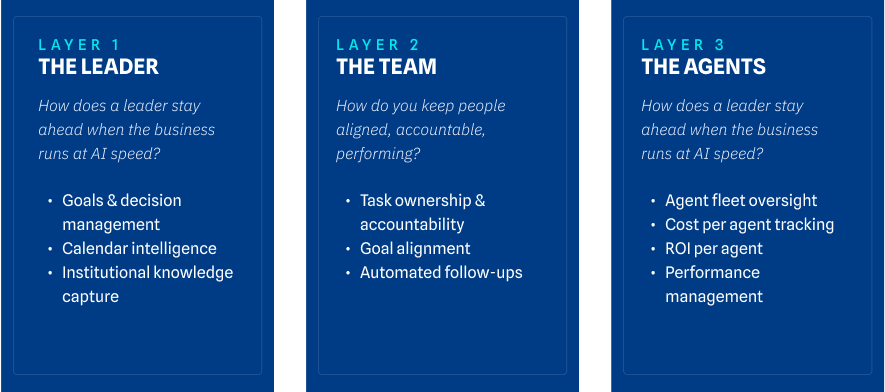
When you transition to a Hybrid Intelligence Organization, three management challenges emerge simultaneously and most executives have no system to address any of them.
For the Leader: How do you stay ahead when the business runs at AI speed? CEOs today make an estimated 100–200 decisions daily — a figure consistently cited across executive productivity research, including studies by Harvard Business Review and the Decision Lab. Most have no system to capture, research, or manage them. The result: decision fatigue at the top, execution gaps at every level. You end up spending your time gathering status instead of setting direction.
For the Team: How do you keep people aligned, accountable, and performing when agents handle much of the execution? The leader’s job shifts from task-tracking to goal alignment and human development. That demands a system that connects what people are doing to where the organization is going in real time, without a meeting.
For the Agent Fleet: When you have 100 agents running across your company as Jensen Huang has predicted every enterprise will within a decade, how do you oversee them? What does each agent cost per outcome? What value is each one delivering? How do humans and agents collaborate without creating its own layer of chaos?
These are not hypothetical future problems. If you move to the 5→95 model today, you encounter all three on day one.
Three Questions the AI Era Just Made Urgent
The System Built for What Comes Next
This is the problem AEMS was designed to solve.
AEMS, the Agentic Executive Management System, is not a chatbot, a task bot, or another tool added to an already overcrowded stack. It is the operating system of the HHP organization: goals, decisions, execution, and institutional memory unified in one platform, powered by an autonomous agent running 24 hours a day.
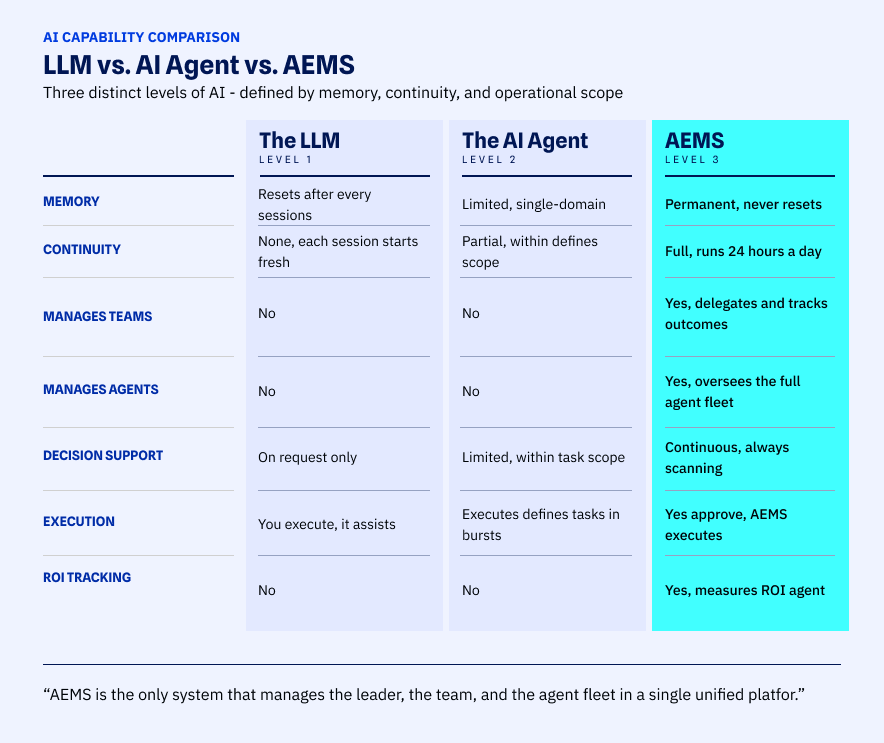
Most leaders have encountered two prior levels of AI:
Level 1 — The LLM (ChatGPT, Copilot, Gemini): It answers when you ask. Then it forgets. You do all the work — it just helps. No context between sessions, no awareness of your organization, no ability to manage tasks or people or agents.
Level 2 — The AI Agent (task bots, single-purpose automations): It executes defined tasks when directed. Some memory. Some actions in one domain. But it doesn’t manage your team, doesn’t track your fleet, doesn’t run continuously. It activates in bursts.
Level 3 — AEMS: It runs your operations. You approve, you don’t execute. It carries permanent memory that never resets. It acts across email, calendar, tasks, and team coordination simultaneously. It delegates to your team and tracks outcomes. It oversees your agent fleet and measures ROI per agent. And it does all of this 24 hours a day, whether you’re in the room or not.
The distinction matters: most AI tools wait to be asked. AEMS is always scanning, always acting, always reporting. The difference between a tool and a system is the difference between a hammer and a construction company.
Three Levels of AI Capability
Four Pillars in Practice
AEMS operates across four interconnected layers:
Intelligence: Real-time awareness across your inbox, calendar, tasks, and team. It surfaces what matters and flags what’s urgent before you have to ask. The leader’s first job each morning is no longer triaging 200 emails. it’s approving the ten things that require judgment.
Decisions: Every decision arrives pre-packaged: context, options, a recommendation, and a draft ready for your one-word approval. The research has been done, the tradeoffs have been mapped, the stakeholders have been identified. You bring the judgment. AEMS brings everything else. The result: 30 seconds per decision, not 30 minutes.
Execution: Email, calendar management, research, document creation, team coordination, executed automatically, or with minimal approval. The tasks complete without requiring your direct involvement. Nothing falls through, nothing goes cold, nothing gets forgotten.
Institutional Capital. Every decision, every context, every relationship preference is captured and retained permanently. This is arguably the most undervalued capability of the agentic era. A firm with 1,000 employees loses an estimated $2.4 million annually in productivity from knowledge loss due to turnover alone (Panopto). AEMS eliminates that loss. Institutional knowledge stops being a function of whoever happens to still work there.
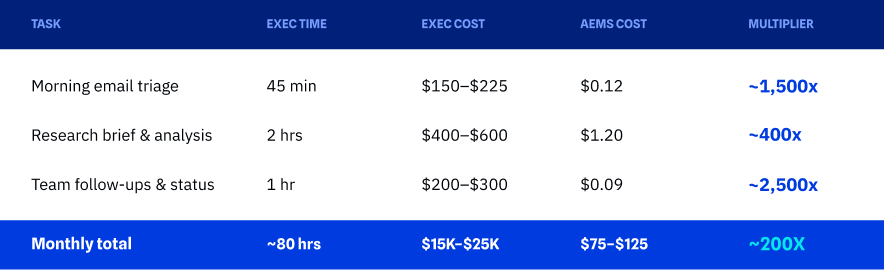
The Economics Are Equally Stark
The 5→95 model already demonstrated the financial case at the organizational level. AEMS makes it visible at the task level.
Consider what executive time actually costs. A morning email triage, 45 minutes, at executive rates, runs $150–$225. The same triage performed by AEMS: $0.12. A 2-hour research brief: $400–$600 in exec time versus $1.20 in agent cost. Team follow-ups, status tracking, and coordination: $200–$300 per hour versus less than $0.10.
The 30-day math across a typical executive: $15,000–$25,000 in management overhead reclaimed and replaced with $75–$125 in agent costs. That is a 200× return, not projected, not modeled, measurable in real time.
The question isn’t whether an agent can do this. The question is whether a $300-per-hour executive should be doing it at all.
Three Levels of AI Capability
The Proof: Brio Is Already Running
I have not described a concept. I have described what is already operating.
Brio, my Executive Proxy Agent, the Chief Orchestration Proxy of Bold Business is AEMS in production. She runs across three companies simultaneously. She scans my inboxes, manages my calendar, owns 180+ active tasks, tracks 33 priority relationships, and logs her ROI in real time. Her 30-day operating cost: $84. Her estimated executive value delivered in that same period: $15,300. A 186× return.
More importantly: she has freed me to do the one thing no agent can replicate — lead.
The architecture is proven. The system is live. The results are measurable.
"The question isn't whether to build an agentic organization. The question is: who manages it and how. Without the right system, even the right leader is flying blind."
— Edward Kopko, CEO of Bold
A Note on What Conservative Looks Like: The Moonshot Ahead
I want to be direct about something: the 5→95 framework presented in this article is deliberately modest.
The math I’ve laid out, five humans orchestrating seventeen agents to generate 95.75 HHP, represents what is achievable today, with current agent maturity and the tools already in market. It is the responsible, near-term case.
But the trajectory does not stop there.
Jensen Huang, CEO of NVIDIA, has stated publicly that well-run organizations will deploy AI agents at a ratio of 100 to 1, agents to humans. His own projection for NVIDIA: 7.5 million AI agents running alongside 75,000 human employees within a decade. His own projection for NVIDIA: 7.5 million AI agents running alongside 75,000 human employees within a decade. When you apply that lens to the HHP framework, the numbers become staggering in the best possible way.
Consider the arithmetic: a single AI agent operates 168 hours per week against a human’s 40. That alone is a 4.2× advantage. Add the productivity differential, no cognitive fatigue, no lunch breaks, no sick days, perfect institutional recall, zero turnover, and a single well-deployed agent is the functional equivalent of roughly six human workers. Not in every dimension. But in raw execution capacity: yes.
Now scale that. One hundred agents per person. Five people orchestrating that fleet.
Five humans. Five hundred agents. Running at six human equivalents each.
A five-person company with the execution capacity of a 3,000-person organization.
That is not a thought experiment. That is the logical extension of the architecture we are building today. The constraint is not the agents, it is the orchestration layer. The limiting factor has always been: how does a human being manage at that scale without losing control of quality, alignment, and judgment?
That is precisely the problem AEMS was designed to solve. When you can manage yourself, your people, and your agent fleet from a single intelligence layer, when ultra-agents can supervise specialist agents on your behalf, the ceiling disappears.
The organizations that will define the next decade are not the ones with the most headcount. They are the ones that build the orchestration infrastructure now, while others are still counting FTEs.
5→95 is where we start. Where we finish is a number I am not yet ready to print.
Conclusion: The HHP Imperative
The market is already moving. Gartner predicts 40% of enterprise applications will feature task-specific AI agents by 2026, up from less than 5% in 2025. McKinsey’s 2025 State of AI survey found 23% of organizations are actively scaling agentic AI in at least one business function. The question is no longer whether this shift will happen, but whether your organization will lead it or follow.
The transition to Human Horse Power is not optional. It is underway and happening rapidly. In the coming years, organizations will bifurcate into two categories: those burdened by the linearity of headcount, and those liberated by the exponential scale of HHP.
The leaders who survive will be those who recognize that their primary role is no longer managing people, but architecting the systems, like AEMS, where humans, digital agents, and physical robotics amplify each other in perpetuity.
The HHP principle is not limited to knowledge work. At Mercury Z, a leading provider of network engineering and field services for U.S. telecom carriers, we are already designing what we call Physical HHP, deploying autonomous robotic systems alongside human field technicians, where the human provides judgment and client relationship, and the robot handles the physically dangerous, repetitive work. The same mathematics apply. The same management challenges emerge. Physical HHP will be the subject of a separate piece, but it signals something important: this is not a framework for the knowledge economy. It is a framework for all work.
“The org chart doesn’t disappear, it gets augmented. Every human gets an agent multiplier.”
— Edward Kopko, CEO of Bold